

By Paul Dunwell, writing for EasyFrame
© Copyright EasyFrame 2021
What this article is about
Katsushika Hokusai's woodblock print 'The Great Wave off Kanagawa' (also known as 'Under the Wave off Kanagawa', 'The Great Wave' or simply 'The Wave') is an iconic masterpiece, one of the most famous works ever made. It conveys the menace of a claw-like rogue wave in Sagami Bay, near modern Yokohama, with Mount Fuji some 50 miles away in the background. The peril of the three boat crews makes it timeless. The mountain's peak is associated with eternal life, which contrasts starkly with the life expectancy of fishermen such as these.
Hokusai (1760 to 1849) was a prolific 'ukiyo-e' artist, a maker of 'pictures of the floating world', the school that dominated Japanese art from the 17th to the 19th century. He was known for illustrating everyday life. His 30,000 or so works take in fish, birds and other animals, craftsmen and courtesans, actors and grandees, bridges and landscapes. But he loved the sea, and drew other monster waves at places such as Kajikazawa and Chōshi.
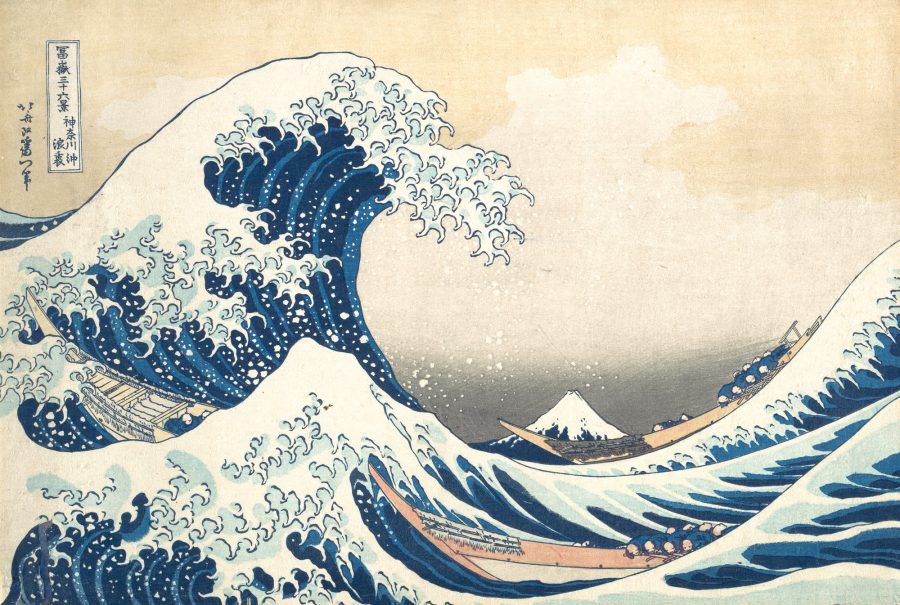
Hokusai was a great artist, but his genius lay in more than composition. Rather than making single pieces to hang in palaces, he designed for a mass market, and his work decorated homes all over Japan. He could never have known that, shortly after his death, it would reach a global market and influence scores of artists, or that 'The Great Wave' would be recognised by billions of people nearly two centuries later. This article explains why it deserves to be.
The artist
Born in 1760 and first named Tokitarō, Hokusai said he began to draw at six. He was widely known by 60, which is the more remarkable given that he used at least 30 different names. He was still at work when he died at 88. He had hoped to reach 110, and always reckoned, perhaps tongue in cheek, that he'd be good in another five years.
His father is thought to have been a mirror-maker to the shōgun, and it has been suggested that his mother was a concubine, which might explain why he was not made his father's heir. As a boy he worked in a lending library, and at about 14 he was apprenticed to a woodblock carver. At 18 he joined the studio of a leading print designer. In mid-career he worked under the name Tawaraya Sōri, which he later passed to a pupil.
Hokusai was a bit of a performance artist. Asked to show his skill before the shōgun, he famously painted a broad blue line on paper, dipped a chicken's feet in red paint and chased it across. The effect was of maple leaves floating on a river. He also painted a vast portrait of Daruma, the founder of Zen Buddhism, with a broom for a brush.
Such self-promotion came naturally, because Hokusai was commercially astute. He had a great sense of line, and he understood how everything he saw could be reduced to the handful of colours used in woodblock printing. The rest was teamwork. His publisher employed specialist carvers to cut a separate block for each colour, and printers to print, dry and distribute the results.
He did not only design decorative prints. He was a one-man whirlwind who produced board games, instruction manuals, paper lanterns and cut-out dioramas. All that creativity bred chaos. It is said that Hokusai would look around, decide his lodgings were a pigsty, and move somewhere else rather than tidy up. He is supposed to have moved more than 90 times.
We cannot be sure of everything Hokusai made, because in 1839, a decade before his death, much of his work was destroyed in a calamitous fire. Thankfully he stayed productive to the end. Four years after he died, the American Commodore Perry used gunboats to end Japan's two centuries of self-isolation, or 'sakoku'. After that Hokusai's prints sold widely in Europe. Some are said to have arrived there as packing paper.
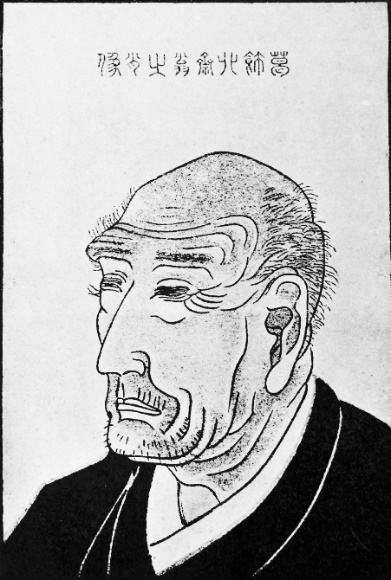
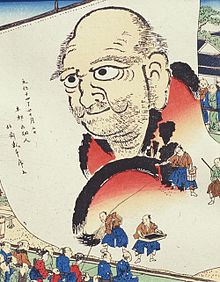
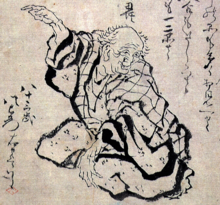
Some of Hokusai’s self-portraits. One cannot accuse him of vanity!
The process and the colours
Quite apart from the skill needed to carve separate blocks that register exactly with one another, the printing was specialised handwork. No two prints are quite the same, because the printers varied the strength of each colour and often graded the sky by hand.
You can see this if you compare several impressions of 'The Great Wave'. The dark and pale blues differ a little, as do the beige of the boats and the tone of the sky.
All this took time and application, but mass production covered the cost. 'The Great Wave' was probably printed in its thousands, which is why quite a few collections have an original.
One of the colours used to such effect was Prussian blue. It was a synthetic pigment, first made in Berlin (hence the name), and it reached Japan through the few foreign traders allowed in. Hokusai's use of that vibrant colour was to be a great influence on other artists, in particular Vincent van Gogh, who with his art-dealer brother Theo was an avid collector of Japanese prints.
This particular piece
What else can we say about 'The Great Wave'? It shows the love and mastery of balance and harmony that we so often see in Japanese gardens, architecture and interiors. It is simple. It links the frothing, fleeting crest of the wave with the permanence and solidity of Mount Fuji behind it. In outline they are alike.
The scene reminds us of the fragility of life and of society's reliance on bravery. The streamlined 'oshiokuri-bune', fast boats that carried fresh fish to market, are ingenious craft, but look terribly fragile beside towering waves that weigh a ton for every cubic metre. Such boats were 12 to 15 metres (39 to 49 feet) long. Allowing for some exaggeration by the artist, that puts the wave at 10 to 12 metres (33 to 39 feet), about three storeys. And you can see the crews huddled beneath it. They aren't comfortable! Such precise detail is amazing given the limits of the materials.
Who did Hokusai influence?
This piece is all about line, harmony and an idea, and it forsakes fussy detail. It was bound to appeal to the European Impressionists when they saw it. Van Gogh has been mentioned, but Degas, Gauguin, Toulouse-Lautrec and Monet are all known to have been influenced by Hokusai, as were the Art Nouveau masters Klimt, Lalique and Mucha.
Conclusion
Hokusai had a matchless feel for form and colour, and he turned it into affordable masterpieces so timeless that they still sit well in modern surroundings.
You can buy prints of 'The Great Wave off Kanagawa' from suppliers such as www.allposters.co.uk.
You'll want to frame whatever you buy. Any good framers will show you a range of solutions and advise on what suits the work and where it will hang. You can contact EasyFrame on 01234 856 501 or at sales@EasyFrame.co.uk, and they'll always chat even if you don't want to buy!