


If there is one artist unlikely to end up framed on most people's bedroom walls, it is Hieronymus Bosch. There is no denying the talent of this Netherlandish painter, once called 'the devil's painter'. But anyone who has seen his work knows it could give nightmares to the hardiest horror fan.
If you are in the mood for some skin-crawling art, here is a crash course in everything Bosch.
Bosch's background
For all his fame, little is known about Bosch's early life. He is thought to have been born around 1450, but the date is not certain. We do not know where or how he learned to paint, because he left no diaries or letters. We do know that he was born Jheronimus van Aken, and that he took his name from his home town, Den Bosch, or, to give it its full tongue-twisting title, 's-Hertogenbosch.
Bosch died in 1516 and was buried in his home town. He left triptychs, diptychs and small panel paintings, mostly in oil on oak. Some of the surviving paintings are fragments of larger works that have been lost. There are also drawings, some of them studies for the paintings.
Bosch's unusual themes
Anyone who knows Bosch at all associates his name with surreal, disturbing images of sin and punishment. As a painter of the late 15th and early 16th centuries he was naturally concerned with religious subjects, but historians still argue about what he meant by them.
He has been accused of painting to amuse and titillate, and other critics have called his work heretical. Today it is more widely accepted that his paintings, bizarre as they look to us, were in keeping with the religious beliefs of his time.
Seen that way, his visions of Heaven and Hell came from the ideas of his day about morality, sin and salvation, not from a wish to shock. Some experts argue that his strange images are pictures of the sayings, sermons and folk tales his contemporaries would have known.
The Garden of Earthly Delights
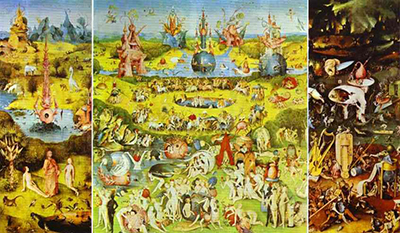
Bosch's most famous painting is the triptych 'The Garden of Earthly Delights', made at some point between 1490 and 1510. Over two metres high and nearly four metres wide when open, it hangs in the Museo del Prado in Madrid.
Unlike an ordinary framed painting, it folds. The two outer panels close over the centre like shutters, and reveal another painting on the outside, which is generally thought to show the creation of the world.
Inside, the three panels are read from left to right:
- Left: Eden. God stands between the figures of Adam and Eve.
- Centre: the garden of earthly delights. God is nowhere to be seen. The scene is crowded with naked men and women pursuing pleasure.
- Right: Hell. The green fields and blue skies are gone. Black mountains smoke in the distance, and in the harsh light of the foreground, figures much like those in the centre panel are tormented, humiliated and devoured by strange creatures.
Read in that order, the message becomes clear: without God, the descent into torment is inevitable.
Other important works
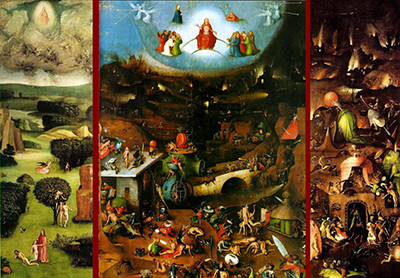
The same fantastical beasts appear in another triptych, 'The Last Judgement'. The left panel again shows Eden, with the creation and temptation of Eve. The centre shows the Last Judgement itself, where the damned have already begun to receive their punishments at the hands of bizarre and terrifying creatures. On the right the torment continues in Hell, now overseen by Satan.
'The Haywain' tells a similar story to 'The Garden of Earthly Delights', and the four panels known as 'Visions of the Hereafter' set scenes of Hell against scenes of Heaven.
In many of his other works the monsters are absent, but there is the same preoccupation with sin, folly, ugliness and the hope of salvation.
Getting to know Bosch
If you are intrigued, the best way to learn more is to see the paintings. They are scattered across the world's galleries, with 'The Garden of Earthly Delights' and 'The Haywain' both in the Prado.
If a trip round Europe is not practical, it has never been easier to bring art home. Order a good print of a favourite work and have it framed. At EasyFrame you choose the exact style and size of the frame and mount. Bosch's visions of Hell may be ugly, but your frame need not be!
To learn more, visit our picture frames and mounts page.