

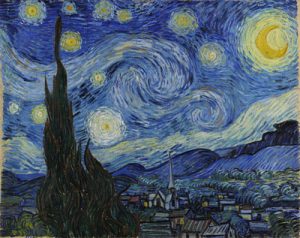
At EasyFrame we love art of all kinds, even the kind that does not fit in a picture frame. We are also rather envious of anyone who can pick up a brush and produce a masterpiece. Of course, there is far more to being an artist than natural talent. Consider what goes into a painting in oils.
Artists have used oil paint for centuries, and most of the world's best-known paintings were made with it, including the 'Mona Lisa', 'The Starry Night', 'Girl with a Pearl Earring' and Mark Rothko's 'No. 10'.
The term covers any slow-drying paint made from pigment mixed with oil. Painters like it because it lasts, and because its slow drying lets them make corrections gradually. It can also produce effects that are impossible in other kinds of paint.
The origins of oil paint
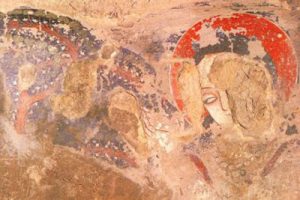
In 2008 researchers reported that paintings in caves in Afghanistan, dating from about 650 AD, had been made with oil paint, using pigments in walnut and poppy seed oils. They are the earliest oil paintings known.
It was not until the Renaissance, however, that oils were widely used by artists. In the classical and medieval periods, oils were used for varnishing and sealing, and now and then to add detail to tempera paintings. Tempera is a technique in which pigments are mixed with a water-soluble binder, often egg yolk. Oil's long drying time was generally seen as a drawback. In the 15th century that began to change.
The Renaissance: oil paint's heyday
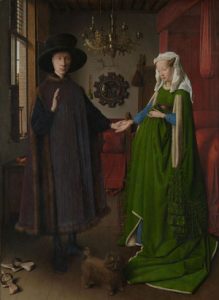
Until the 15th century, tempera was the preferred medium. But the move towards naturalism, led by the early Netherlandish painters, showed up its limits. Tempera dries quickly and lasts well, but it could not give the realistic detail and subtle gradation that painters now wanted.
It is often said that the Flemish painter Jan van Eyck invented oil painting. It is nearer the truth to say that he was an early and very influential master of it. His painting of 1434, 'The Arnolfini Portrait', was a turning point for Western art. By blending colours while they were still wet, and building up delicate, translucent layers, he showed the rest of the art world how intense and powerful oil paint could be.
Exactly what mixture Van Eyck used is not known. Later painters experimented with their own recipes. Antonello da Messina is credited with an oil cooked with a lead compound, which dried better, and Leonardo da Vinci added beeswax. Some of those mixtures have darkened with age, which is one reason other methods are used today.
The paint tube
Until the middle of the 19th century, artists or their assistants made their own paint, grinding pigments and mixing them painstakingly with oil. Then, in 1841, the American portrait painter John Goffe Rand invented the tin paint tube.
It was revolutionary. Paint no longer dried out, and artists could work outdoors with ease. Pierre-Auguste Renoir is famously quoted as saying: 'Without tubes of paint there would have been no Impressionism'.
Oil painting today
The appeal of oil paint has not dimmed since the Renaissance, even with the arrival of fast-drying acrylics. It is much easier now to get the effect you want, because so many materials are available. Painters often add things to their paint to change how fast it dries, how thick it is or how it finishes.
- Wax can be added as a stabiliser, and in larger amounts helps with impasto, in which paint is built up in thick layers that show the marks of the brush or knife.
- Synthetic resins add gloss and speed up drying. Natural tree resins dissolved in turpentine were once used for the same purpose, but they often led to cracking and yellowing.
- Solvents such as white spirit and turpentine thin the paint and make it dry faster. They are often used for the first layers of a picture, which can then be painted over.
Oil paintings in your home
If this has inspired you to try painting, remember that EasyFrame can help with the framing. We offer a wide range of frames and mounts, all made to the exact size of your masterpiece.
As well as standard frames for flat pictures, we supply canvas frames, designed to fit stretched oil paintings and canvas prints that are too deep for an ordinary frame.
Find out more about custom picture framing on our picture frames and mounts page, or see our canvas frames.