

To have your portrait painted today would mark you out as an artist's muse, or as rich and famous. In the age of the smartphone, the rest of us record ourselves in photographs.
Before the camera, a painted portrait was the only way to record what a person looked like. It was mostly for the wealthy, but it played a practical part in people's lives.
After the camera, the portrait had to change. Exact likeness mattered less. Painters turned to portraits that caught something of a person's spirit, and conveyed meaning through colour, viewpoint and composition.
In honour of that history, and to inspire anyone thinking of hanging their own likeness in a vast gold frame, here are seven of the most significant portraits ever made.
'Marilyn Diptych', Andy Warhol (1962)
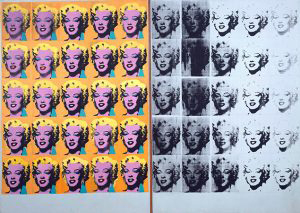
Less a portrait than fifty of them. The Pop Art pioneer Andy Warhol made this silkscreen in the weeks after Marilyn Monroe's death, and the contrast between the coloured images and the fading black and white ones seems to hint at life and death.
The fifty identical images are based on a publicity photograph for her film 'Niagara'. The work is widely read as a comment on our obsession with celebrity. With 'Campbell's Soup Cans', it is Warhol's most famous and influential piece.
'Self-Portrait with Thorn Necklace and Hummingbird', Frida Kahlo (1940)
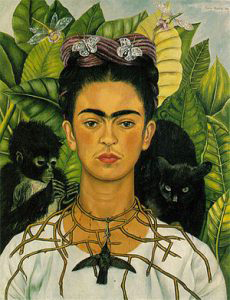
Frida Kahlo painted many self-portraits, and this is perhaps the best known and best loved. Like much of her work it combines the natural with the symbolic and the surreal. Painted after her divorce from Diego Rivera, it seems to point to both suffering and renewal. A necklace of thorns digs into her neck and draws blood, but the vivid green leaves and blue sky around her suggest hope.
'Self-Portrait', Vincent van Gogh (1889)
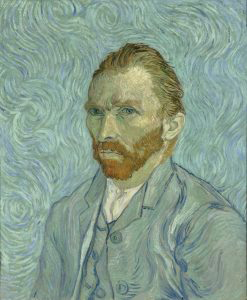
Van Gogh was another prolific painter of portraits, of himself and of others. This one was painted in the year before his death, and some historians believe it was his last self-portrait. It shows the artist in a blue jacket and waistcoat against a background in the same blues, which set off his red hair.
At first glance it is a calm, almost pretty picture. Look longer and there is something haunted and agitated in the face. The swirling brushwork of the background and the jacket suggests a disquiet that threatens to engulf him.
'Girl with a Pearl Earring', Johannes Vermeer (c. 1665)
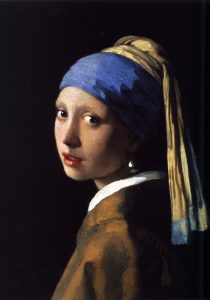
The Dutch painter Johannes Vermeer is known for his handling of light, and nowhere is it clearer than in his most famous work. A young woman looks out from a dark background, her head turned over her shoulder. Light falls across her face, her headscarf and, of course, the large pearl at her ear.
It is hard to say exactly why this portrait is so popular and so lasting. It has inspired a novel and a film. But as with all the greatest paintings, the eye returns to it again and again.
'The Weeping Woman', Pablo Picasso (1937)
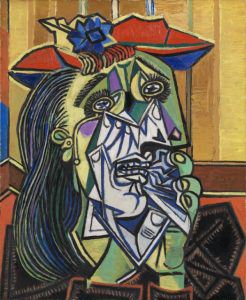
With 'Guernica', 'The Weeping Woman' is the painting many people picture when they hear Picasso's name, and the two are closely related.
After the bombing of the Basque town of Guernica in the Spanish Civil War, Picasso set out to show the horror of war. When 'Guernica' was finished, he remained obsessed with one of its figures: a woman weeping as she holds her dead child.
For months he painted variations on the theme, and 'The Weeping Woman' was the result. It is based on the features of his companion Dora Maar. The Cubist fragmentation conveys how grief breaks a person apart, and the bright colours convey the intensity of the feeling.
'Portrait of Madame X', John Singer Sargent (1884)
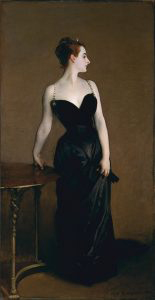
When it was first shown, Sargent's 'Madame X' caused quite a stir. Critics thought the bare skin and low neckline too provocative.
The original version showed one strap of the dress slipping from the shoulder. In response to the outcry, Sargent repainted it. By today's standards the painting is hardly scandalous, but it keeps a vivid sensuality that sets it apart from every other portrait here.
'Mona Lisa', Leonardo da Vinci (c. 1506)
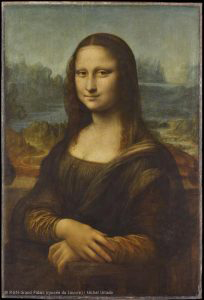
No list like this would be complete without the most famous painting in the world. In the Louvre in Paris since 1797, the 'Mona Lisa' is best known for the enigmatic expression of its sitter, Lisa Gherardini. It has been praised for its realism, its mystery and its romance, and it has inspired many other works, among them Marcel Duchamp's 'L.H.O.O.Q.', a cheap postcard of the painting with a moustache and beard drawn on.
Its lasting appeal puzzles some people, particularly those who rate Leonardo's other works more highly. At EasyFrame we will always have a soft spot for that smile.
Hanging portraits in your home
If this list has inspired you, it is easier than ever to find excellent reproductions of famous paintings, and with EasyFrame you can have one in a made-to-measure frame and on your wall in no time.
To find out more, visit our picture frames and mounts page.