

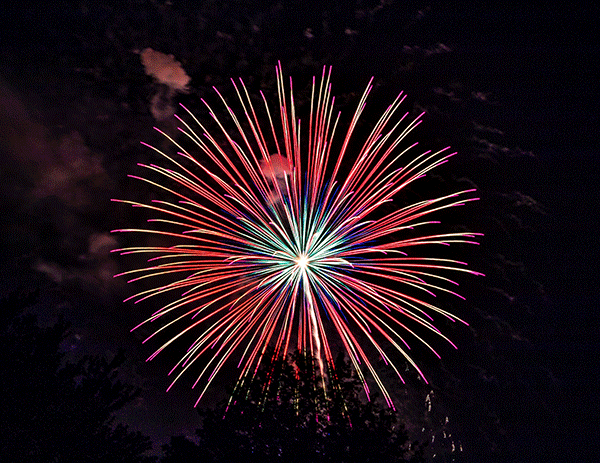
After November 5th, most of the firework-related work we are asked to do is framing our customers' photographs. Photographing fireworks is technically challenging and needs a different approach from most subjects. Follow these steps and you'll improve your chances next time.
What you are really photographing
Boil it down and you are photographing streaks of light that develop over time against a black background. A black background makes no impression on the sensor or film, so you can leave the shutter open as long as you like and the sky will stay black.
Set the camera to manual exposure, choose a suitable aperture and set the shutter to 'B' (bulb). Open the shutter just before the firework bursts and close it just after. It's as simple as that.
Use a strong tripod
You need a strong, sturdy tripod. Exposures last several seconds, and without one you will struggle. A remote shutter release makes life easier still, because you don't have to touch the camera at all. In the past that meant a cheap cable release. Today wireless ones are easy to find online.
Focus manually
Autofocus is no use here. The lens will hunt backwards and forwards trying to find something to lock onto in the black sky. Switch to manual and focus on something a good distance away. Don't just wind the focus ring to the end of its travel. Check it against a distant object if you can.
Aperture and ISO
Exposure depends on the brightness of the firework, from the first burst to the trails spreading across the sky. You can't meter it accurately. There is too much contrast for your camera's metering to give a useful reading, so the best guide is what has worked for other photographers.
At ISO 100, an aperture between f/8 and f/16 is about right. Start at f/11 and ISO 100, and be prepared to adjust, especially for very bright fireworks.
Plan the picture
Think about composition before the display starts. A wide shot that includes some foreground, such as the silhouette of a building, a floodlit object or the outline of the crowd, makes a far more interesting picture.
Framing your shots
Once you've chosen your best image, you could frame it with a memento of the evening, such as the ticket stub from the display. You could add the case of a spent rocket in a deeper box frame with your photograph behind it. (Never frame a live firework.) Or make a montage of all the photographs you took that night.
Let us know how you get on, and do send us your favourite pictures.
Need a frame for your firework photos? Call EasyFrame on 01234 856 501 or email sales@EasyFrame.co.uk. We'll always chat, even if you don't want to buy.