

By Paul Dunwell, writing for EasyFrame
© Copyright EasyFrame 2020
View our range of vinyl framing layouts
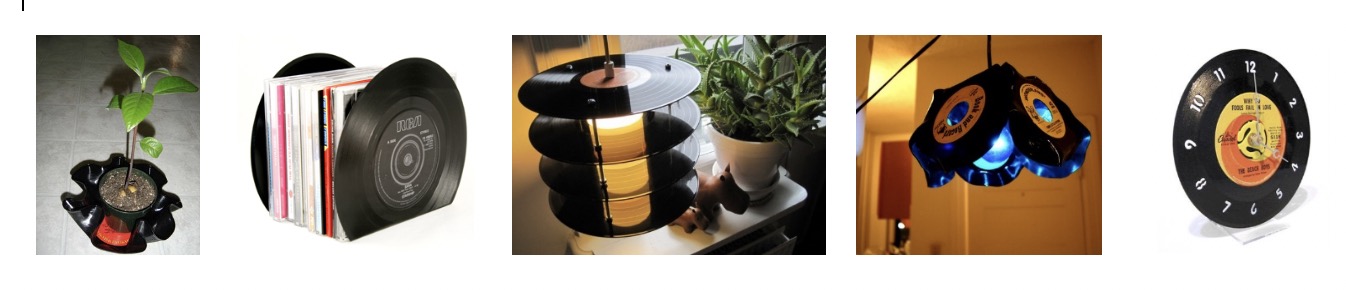
What this article is about
There was a time when the humble vinyl disc, like the turntable it was played on, looked consigned to obsolescence. It wasn't alone. Remember the 8-track systems in cars such as Zephyr Zodiacs? Or cassettes you had to rewind with a pencil? Vinyl was like them: an anachronism, a museum piece, if it hadn't been turned into a plant-pot holder (see above; we'd still recommend this for, say, Mr Blobby's 1993 Christmas hit). Even CDs are going the same way now that people prefer downloads. Yet, against all odds, there has been a sustained revival of interest in the vinyl record and the record player, and it can't all be put down to nostalgia.
Easyframe has been bombarded with requests to frame vinyl records. They aren't all copies of 'The Sound of Music' sent by spouses and flatmates who realise that a record safely framed on the wall can't be played endlessly! So here we look at the history of vinyl, the revival, why vinyl suits framing, the service Easyframe provides and the results it delivers.

How it all started
After so many successful years there's not much Easyframe hasn't been asked to frame, and there was always the odd request for a record. But interest in, and sales of, vinyl have grown greatly since 2007. The feeling was that digital music had become too perfect and lost the soul of analogue. Listeners wanted to hear the needle drop, the dust and static crackle, the plectrums and fingers on fretboards. They were suddenly proud to buy, own and play retro recordings. That pride is now trickling through to framers.

There are vinyls and there are vinyls:
- LPs. In 1948 the 10-inch or 12-inch long-playing record, running at 33 rpm, replaced the old 10-inch 78 rpm format that had been around since 1900. LPs were pressed in bulk on huge hydraulic presses.
- Singles. By the 1950s we had 7-inch pressings at 45 rpm, usually with one track a side. That coincided with the arrival of the UK 'Top 20' in 1954. Mono recordings gradually gave way to stereo, more or less completely by 1970. David Bowie's 'Space Oddity' was certainly one of the first stereo singles.
- EPs. The 'extended play' format has three to six tracks and supposedly a maximum play time of 25 minutes. Lady Gaga, Miley Cyrus and Stevie Wonder have all used it.
- Maxi-singles. Mungo Jerry's 1970 worldwide hit 'In the Summertime', which has sold over 30 million copies, was 7 inches across like a single but played at 33 rpm like an LP. It had three tracks, and others by the band had more. With a proper sleeve instead of a flimsy white one, they were considered good value.
- 12-inch singles. These special, often 'extended', editions were popular in the 1980s. Orchestral Manoeuvres in the Dark used the format for 'Joan of Arc' and The Cure for 'Love Cats'.

Singles went into decline when CDs became popular in the mid-1980s, and LPs followed. Nobody but the most devoted expected a vinyl revival. There was a thriving business in copying whole vinyl collections onto CD so the records could be dumped, and record decks with digital outputs sold well.
It's amazing when you think about it. Going back to vinyl means buying not just the records but a deck and an amplifier too. That is quite a volte-face for the consumer, and it is mirrored by Sony Music, which stopped making vinyl records in 1989 and went back to it in 2018.
Iconic artwork
Sleeves like Bowie's 'Diamond Dogs' are recognised as collectable art worth framing. See www.udiscovermusic.com/stories/25-iconic-album-covers for ideas.
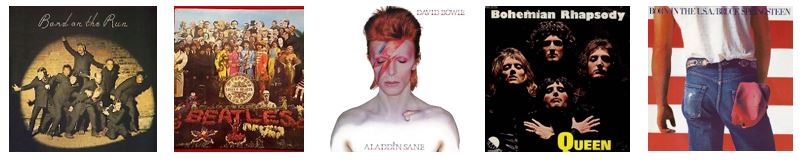
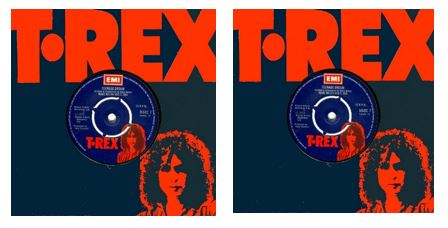
Peter Blake's cover for 'Sergeant Pepper's Lonely Hearts Club Band' notwithstanding, we really have Marc Bolan and T. Rex to thank for the beginnings of glam rock. Their 'sell' was unprecedented. Their singles looked like nothing before them, when standard fare was a plain white sleeve. They stuck glitter on their faces, and would send a video to 'Top of the Pops' instead of turning up like everybody else.
The soundtrack of your life, on your walls
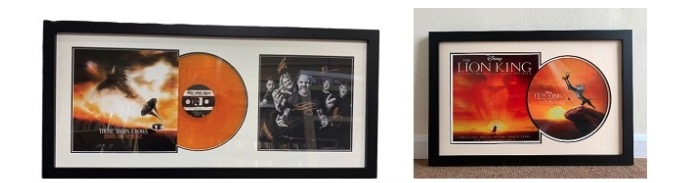
Ask Nick or Rob Zanna what motivates the people who order framed vinyl and they tell of clients who want all sorts of pop paraphernalia framed. Records are often accompanied by programmes, posters and plectrums, or tickets and drumsticks. The discs celebrate the first dance at a wedding, or commemorate what was No 1 when the recipient was born. They are reminders of first dates and dances, and of the music that was playing when proposals, and babies, were made.
Easyframe's vinyl-framing service
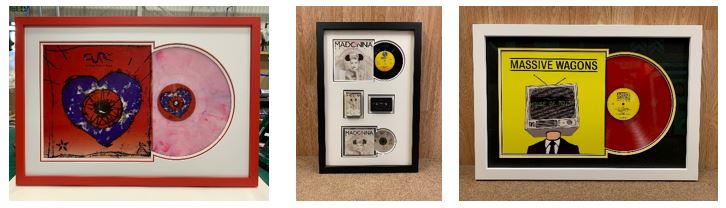
As the examples here show, Easyframe has half a dozen standard designs that suit most orders, and can put together a custom solution for anything special. There is a huge selection of frames, and we can usually do whatever our clients wish. If you're unsure about frame or mount colours, a colour wheel (see https://en.wikipedia.org/wiki/Color_wheel) will help you find colours that work with your discs and sleeves.
Please note that orders are not ordinarily insured, although they are sent by well-known couriers. Any valuable item should be insured. We can arrange that, but must charge for it.
Conclusion
EasyFrame has become a preferred supplier for vinyl lovers who want to preserve mementos of their taste in music, the soundtrack of their lives, in affordable, high-quality frames. Discs are thin and flat, so they lend themselves to framing, and they are a low-cost way to brighten your walls with something that means something to you. Beyond homes and offices, an array of framed records could fill empty wall space in pubs, bars, cafes, restaurants, music venues and dance studios.
To see more of what we do with vinyl, visit www.easyframe.co.uk/vinyl-framing.
To talk to Rob or Nick about framing vinyl or other music memorabilia, call 01234 856 501 or email sales@EasyFrame.co.uk. They will always chat, and they charge nothing for advice.