

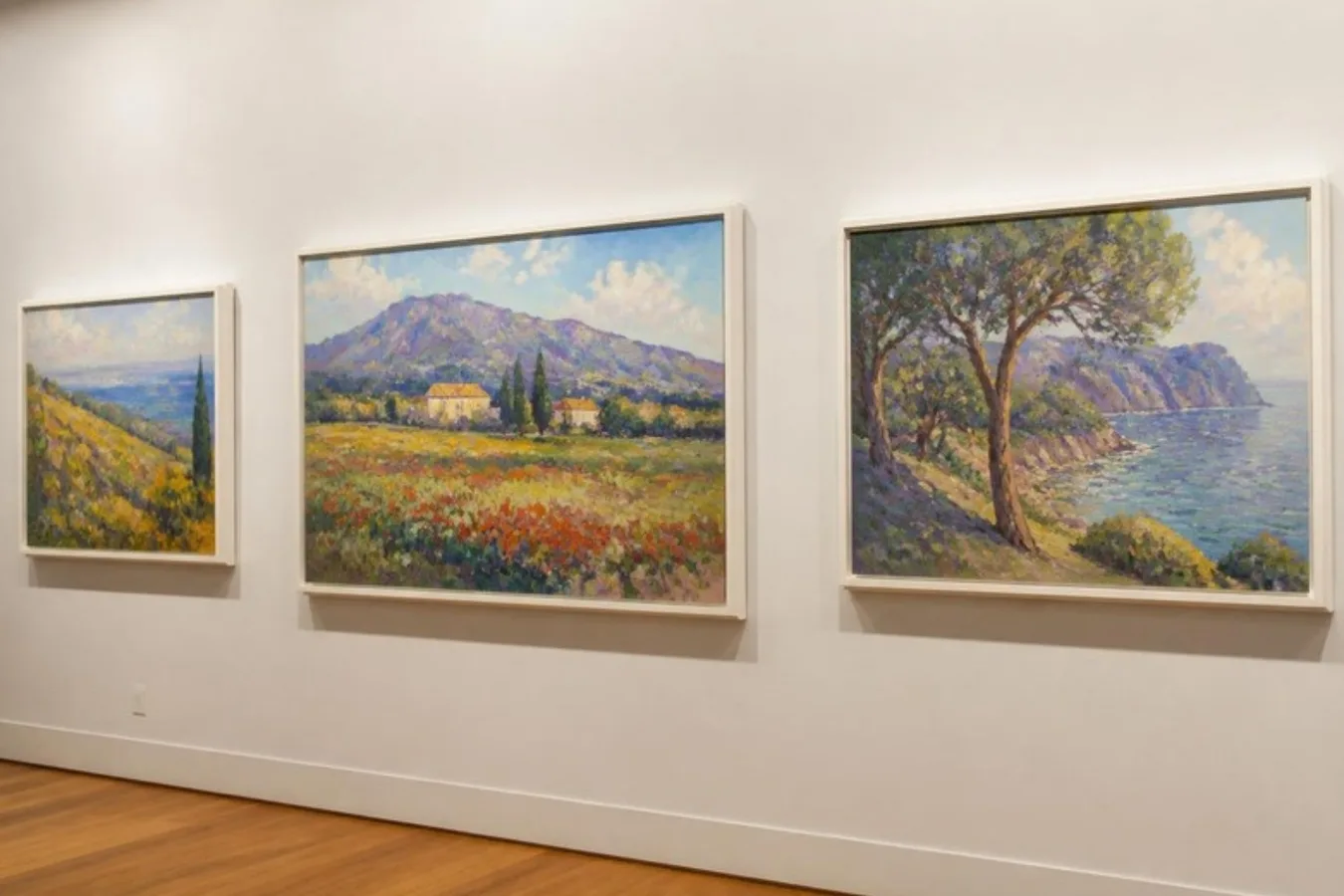
For the third instalment of our "Displaying Art" series we look at the picture frames created between the Post-Impressionist era, which emerged in the 1880s, and the Second World War.
Frames at the start of the Post-Impressionist era
As we saw last time, the 19th century brought increasing variety. Ornate gilded frames stayed popular, largely thanks to compo, a moulded resin that mimicked carved wood. Towards the end of the century, though, many artists began to favour simpler, more modern styles.
Some were Impressionists, most notably Edgar Degas. Others followed a new trend, Post-Impressionism, which pushed back against naturalism and experimented with bright colours, abstraction and symbolism. Its key artists included Paul Cézanne and Van Gogh, whose "Still Life with Grapes, Pears and Lemons" we have mentioned before because of its original frame, painted by the man himself.
The Post-Impressionist who did most to reject framing conventions was the Pointillist Georges Seurat. He chose plain, simple frames and was known for creating a double-frame effect by painting a margin around the edges of his works.
- In his most famous work, "A Sunday on La Grande Jatte", a border of fine blue, red and orange dots merges subtly with the picture. The painting sits in a specially designed white frame that contrasts with the busy, colourful scene.
- In the later "Evening, Honfleur" the margin is painted directly onto the frame. Seurat hand-painted it in a complementary palette that extends the calm seascape beyond its own boundaries.
- In the even later "Le Cirque" the margin merges into the frame: a fine dark blue border on the canvas blends into the painted blue frame. Seurat seems to suggest that artwork and frame are indivisible.
As we'll see, artists outside Post-Impressionism took up this idea of merging art with frame.
The early 20th century
At the start of the 20th century many movements were jostling for attention. Post-Impressionism gave way to Fauvism, and Symbolism to Art Nouveau. American Realism came into its own in the United States, Expressionism gathered steam in Germany and Futurism became the exciting new trend in Italy.
Across the board, artists experimented with new styles of frame. Futurists such as Giacomo Balla made works in which the image extended onto the frame, as in this study from 1914, "Abstract Speed + Sound".
In Art Nouveau the frame found new life. As photography became accessible to ordinary people, frames shrank to fit the images, and craftsmen such as Hector Guimard began making small decorative frames, such as this one from 1907.
The 1920s and 1930s
By painting directly onto their frames, artists had begun to suggest that a work had a life beyond its frame. In the 1920s and 1930s the Surrealists explored the idea more seriously, and in particular the relationship between spectator and artwork.
Rene Magritte's "The Human Condition" invites us to consider how we observe and interpret art. By placing a painting within the painting, Magritte plays with what is real and what is surreal. We have to remind ourselves that the scene outside the window is as artificial as the painting on the easel.
The same playfulness extended to framing. In 1936 Salvador Dali created "Couple with Their Heads Full of Clouds", a pair of desert scenes within two head-shaped frames. The framing adds a dimension beyond the scene on the canvas.
In the same decade Hannah Gluck developed the Gluck frame, with three distinctive steps jutting towards the viewer. It was designed to be painted the same colour as the wall, merging with its surroundings rather than, as with Seurat, with the artwork.
American painters dabbling in the surreal were experimenting too. The frame maker George Of made frames for several painters associated with Alfred Stieglitz, including Georgia O'Keefe. The best example dates from 1935 and was made for O'Keefe's famous "Ram's Head and White Hollyhock". Of made it, but the design was O'Keefe's own, inspired by indigenous craft traditions in New Mexico.
Next in the series
As the next instalment shows, picture frames kept changing, particularly after the Second World War. Until then, why not do a little framing of your own? You can design and order a custom-made frame from us and have it dispatched to your home within three days.