

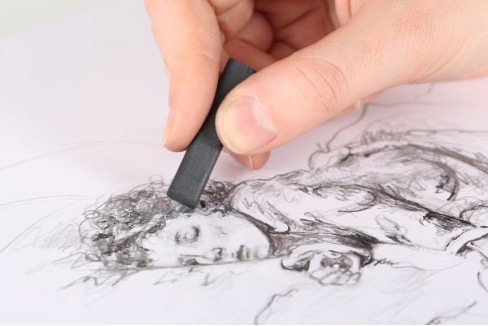
It has never been easier to buy original art. Online marketplaces let new artists sell their work without a gallery or an art fair, in every style and at every price. Plenty of that work is in charcoal, and charcoal needs particular care when it is framed.
Why artists love charcoal
Charcoal is popular with beginners, and art schools and tutors encourage it. Its appeal is that it can be pushed around with a fingertip to blend tones and to make soft lines, hard lines and blurred edges. It has a directness that is hard to get any other way.
Why charcoal is hard to frame
There are two problems. Charcoal sits loosely on the surface of the paper, so it smudges at a touch and can shed dust. And the paper, like any paper, will yellow and weaken if it is kept against acidic card or in strong light, and it takes up moisture from the air.
Making art and framing it are separate skills. Most established artists use a professional framer, so that the frame adds to the piece and protects it. For the same reason, even a charcoal drawing that arrives in a frame can often be improved, and made safer, by reframing it.
Fixatives
A fixative is a spray that helps hold the charcoal to the paper. Many artists apply one when the drawing is finished. Others do not, and leave the choice to the buyer.
Ask the artist whether a fixative was used, and which. Not all are equal. A good one resists smudging and does not discolour, but some can yellow with age, and no frame can undo that. A fixative reduces smudging but never makes a drawing smudge-proof, so the framing still matters.
Attaching the drawing
Never stick a charcoal drawing down with double-sided tape or glue, and do not have it dry mounted. All of these are permanent and can stain.
The drawing should be held to an acid-free backing board in a way that can be undone:
- Hinges. Small T-hinges of acid-free paper tape along the top edge let the paper hang freely, and expand and contract as humidity changes.
- Photo corners. Acid-free corners hold the drawing without any adhesive touching it.
The mount
A window mount does two jobs. It gives the drawing a border, and it holds the glazing away from the surface, so that the charcoal does not rub off on it. For charcoal, a thicker mount or a double mount is worth having, for the extra space.
Use an acid-free (conservation) mount board. Ordinary card is acidic, and over the years it turns the paper it touches yellow or brown.
The window of a mount is cut with a bevel, a sloping edge that leads the eye into the picture. If you want the whole sheet to show, including its edges, ask for a float mount, where the drawing sits on top of the board and spacers keep the glass clear of it. The colour of the mount matters too. Off-white and soft grey suit charcoal well.
Glazing and hanging
A charcoal drawing should always be framed behind glazing. Glass is generally a better choice than acrylic, because acrylic holds a static charge that can pull loose charcoal off the paper. UV-filtering glass slows yellowing and fading. Hang the picture away from direct sunlight and damp.
Conclusion
There is a lot to consider, but it comes down to four things: acid-free materials, nothing permanent holding the drawing, space between the charcoal and the glass, and a spot out of the sun. Our picture frames and mounts are made to measure, and we are glad to advise on the best choice for your artwork.
Call EasyFrame on 01234 856 501 or email sales@easyframe.co.uk. We are happy to talk it through even if you do not want to buy.