

By Paul Dunwell, writing for EasyFrame © Copyright EasyFrame 2018
What this article is about
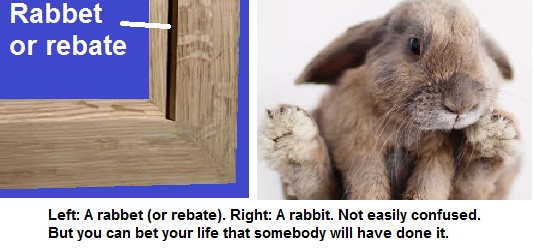
Ever wondered what a 'rabbet' is? Clue: it doesn't have long ears and a cute nose, or taste good in pies. Picture framing might not be rocket science, but it can be complex and time-consuming if you're ambitious, and it has its own vocabulary. If you want to make your own frames, or to instruct a good framer, it helps to know the terms suppliers use.
This article is a run-down of the essential terminology, and a prelude to further 'Frame Academy' pieces on more complex aspects of the dark art of picture-framing. (Yes, there will be sequels, but you won't have to live forever to read them.)
Picture framing terms
| Term | What it means |
|---|---|
| Acid burn | Paper, tape, glue and other products contain acid that can leach into artwork or a photo, turning it yellow and brittle. |
| Acid-free | Products that avoid acid burn. They should have a pH of 6.5 to 8.5. |
| Acrylic | An alternative to glass, also called plexiglass or perspex. It is light, harder to smash and can be UV or glare resistant. |
| Allowance | Paper-based materials expand and contract with temperature and humidity. Allowance is the extra height and width a framer leaves to prevent buckling, usually about 1/8th of an inch or 3mm. |
| Antiquing | Artificially ageing a frame to match its contents, using buffing chemicals or other distressing. |
| Archival framing | Framing for a delicate or valuable item: acid-free, conservation-grade materials, glass or acrylic that prevents fading, and a frame that can be taken apart without damaging the contents. |
| Backing | The board (also called mounting board) that artwork and photographs are placed on before framing, to prevent warping and keep the item square. |
| Bevelled edge | The slope around the edge of the frame that sets off the item on show. |
| Cardstock | Stiffer and thicker than paper. It stops photographs buckling by pressing them against the glass or acrylic. |
| Contemporary style | Up to date: usually clean, unfussy lines, natural wood and metals. |
| Convex glass | Also called 'bubble glass'. Because it bulges outwards, the contents cannot easily stick to it in high humidity. A 1970s fad that, like 'bullion' windows, fell out of favour after it was found, in extreme cases, to start fires. |
| Double mount | Two mounting boards in contrasting colours, used to add depth. The top board has a larger aperture, so part of the bottom one shows. |
| Enamel | A protective, decorative layer used on wooden frames. It may be coloured or transparent. |
| Foam core | An alternative to cardstock that is light, strong, acid-free and ecologically responsible. |
| Frame size | The size of the inside opening measured from the back of the frame, not its outer edges. Allow for any mount around the item. |
| Glazing | The transparent glass or acrylic that protects the contents of the frame. |
| Gilding | Very thin sheets of metal, usually gold but sometimes silver or other metals, applied to the frame moulding. |
| Hinging | Attaching the item invisibly to the mounting board with adhesive tape, which lets it move as temperature and humidity vary. |
| Jersey frame | A purpose-made case for showing off a team shirt or similar. |
| Lignin | A wood-based polymer often found in paper. It can become acidic and damage anything it touches. |
| Lip | The frame's inner edge, which may be bevelled or ornamental. It hides the rabbet and stops the glazing falling out. |
| Mounting | A layer of board that keeps the contents from touching, and sticking to, the glass. It gives a frame-within-a-frame view. |
| Moulding | The visible, decorative part of the frame that holds everything together. |
| Non-invasive mounting | Attaching items to mounting boards, usually with adhesive corners and hinges, so they can be removed later without damage. |
| Ornamentation | Decoration, usually on the moulding, such as beading. |
| Pressure-sensitive tape | Tape that sticks with hand pressure alone, without chemicals or heat. It is easy to apply and to remove. |
| Rabbet/Rebate | The gap under the inner lip of the moulding that holds the glazing, mount, contents and backing. It must be deep enough for all of them, plus a smidgeon of tolerance. |
| Reverse moulding | A moulding with a higher inner lip. It can add perspective, though it is not always pleasing to the eye. |
| Shadow box frame | A cross between a display case and a picture frame, for bulkier items such as baby bootees. |
| Spacers | Thin, clear plastic strips placed on the frame lip to create space between the glazing and the photo, reducing problems caused by humidity. |
| UV rays | Ultraviolet rays in sunlight and artificial light, which eventually damage anything on display. UV-protective glazing reduces the harm. |
Conclusion
EasyFrame is an obvious and affordable supplier, whether you want everything you'd need to do the job yourself or would rather they did it for you. And now you can talk to them in terms that aren't entirely alien!
Any good framer will show you a range of solutions and advise on what suits the work and where it will hang. EasyFrame is on 01234 856 501 and sales@easyframe.co.uk, and they'll always chat even if you don't want to buy!