

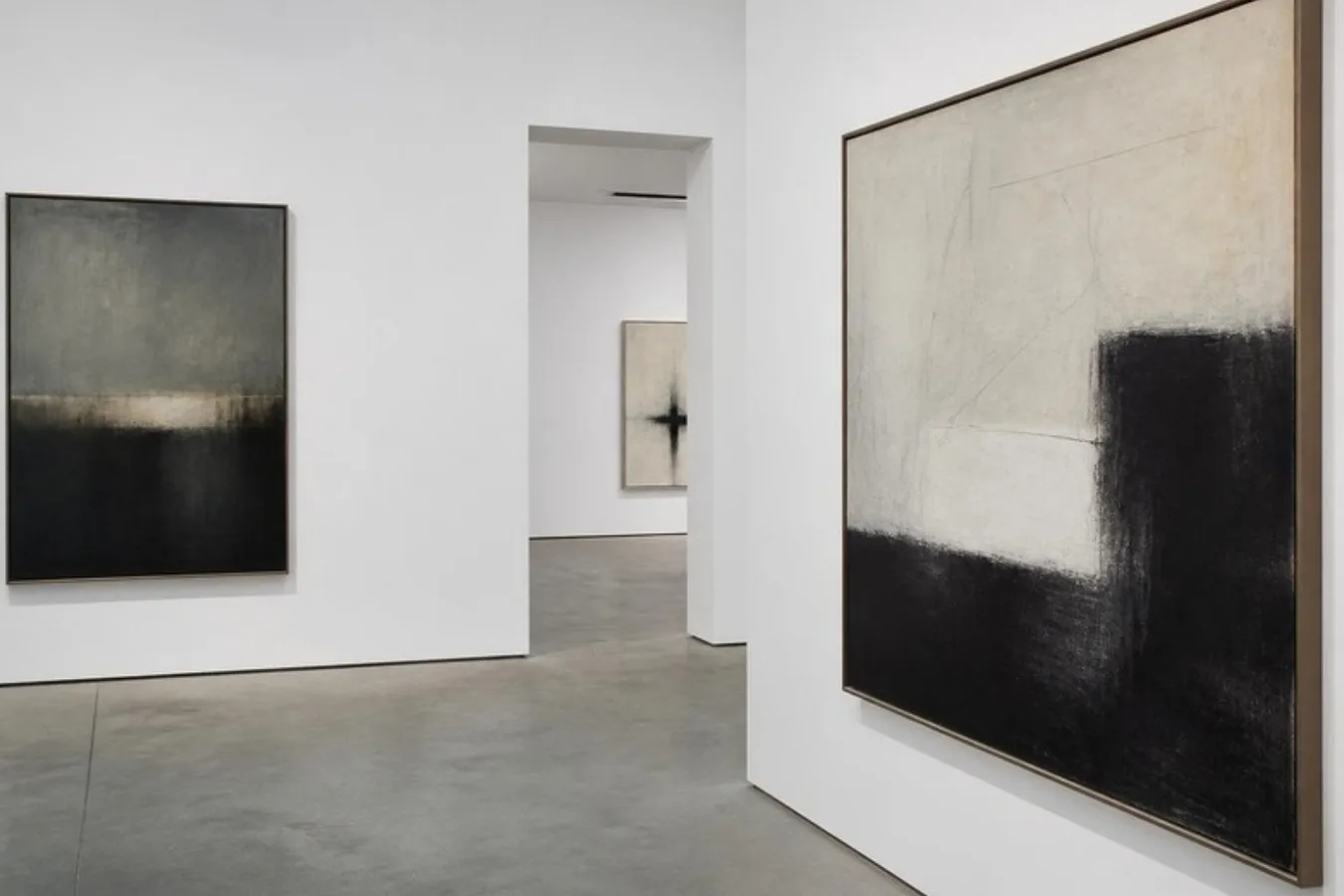
This is the final instalment of our "Displaying Art" series, on how the picture frame has evolved over the last 70 years. As we saw last time, artists, particularly the Surrealists, began to rethink the frame in the 1920s and 1930s by, if you'll forgive the pun, reframing the relationship between artwork and spectator. But it was after the war that the frame was truly revolutionised, largely by one man.
Robert Kulicke and the aluminium frame
Robert Kulicke was a painter, goldsmith and frame designer, born in Philadelphia in 1924. He served in the US Army during the Second World War, became interested in framing afterwards and in 1951 opened his own framing business in New York. He was befriending Abstract Expressionist painters such as Robert Motherwell and Franz Kline, who told him they needed thinner, lighter frames for their work.
In 1956 the Museum of Modern Art asked Kulicke for a frame that could be used for travelling exhibitions. His answer, no doubt shaped by his painter friends, was the welded aluminium frame: strong, thin and elegant, and able to support large canvases. The story goes that it was inspired by Mies van der Rohe's Barcelona chair. Whatever the inspiration, the style was here to stay.
Until the 1950s frames were normally made of wood. Kulicke showed they could be smaller and lighter without losing strength or looks. His next invention was just as pioneering. At the request of the museum's photography department he created the Lucite "plexi box", a clear wraparound box for photographs.
His designs led to others, including the metal section frame pioneered by Donald P. Herbert in the 1960s. This light aluminium frame could be assembled and taken apart quickly, and was also made with travelling exhibitions in mind.
When artists rejected the frame
Walk through a modern art gallery and you'll see many paintings hanging without frames. We don't question it now, but in the 1960s it was fairly revolutionary.
For John Bratby, by the late 1950s, using a frame had become unthinkable. He isn't a household name, but he is known for his colourful depictions of everyday Fifties life and his staunch rejection of the frame. He stuck instructions to the back of each finished canvas saying it should hang on its stretchers alone and that "Ideally, there should be no frame".
At the same time Mark Rothko was creating some of his most famous works, all notable for being unframed. His aversion came from a desire to "eliminate all obstacles between the painter and the idea, and between the idea and the observer".
Rothko inspired many others, but the frame never went out of fashion entirely. During the 1960s the rise of photographers such as Richard Avedon, David Bailey and Helmut Newton created new demand for simple, sophisticated, functional frames and mounts in many sizes. In this photograph from 1969 by Richard Avedon, the frame and mount are used to full effect.
Picture frames today
In the 1990s and 2000s painters such as Howard Hodgkin gave the frame a shot in the arm by making it part of the artwork. In "Come Into the Garden Maud" and "Portrait of the Artist Listening to Music" the paint spills onto the frame, blurring the boundary between, as Rothko would put it, "the idea and the observer". The frame goes beyond its original function and becomes integral to the work.
In 2012 Chris Wilkinson paid further homage with his courtyard installation for the Summer Exhibition at London's Royal Academy: eleven empty picture frames, each 12 metres long, spiralling outwards from landscape to portrait. It was a fitting greeting for visitors, and a reminder that all art is seen through a frame of some sort, physical or not.
Today, better engineering and manufacturing give everyone easy access to all kinds of frames. Nearly all of us carry a camera, and it's unusual to walk into a home without one or two picture frames. Do we have too much choice?
We think too much choice is better than not enough, which is why we let customers design their own frames. On our Picture Frames and Mounts page you enter the exact dimensions of your image, then choose your mount and frame style. We make the frame and dispatch it in three days. We like to think Robert Kulicke would approve.