

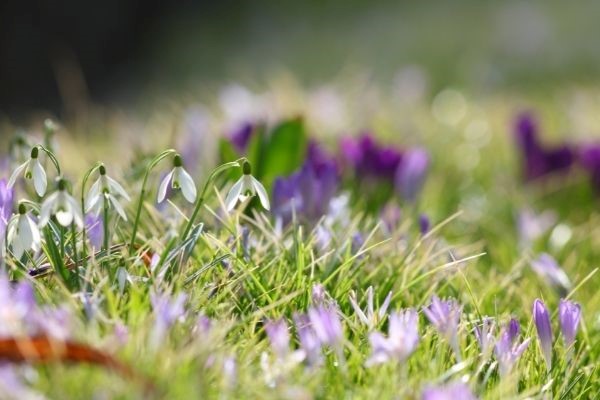
Spring is when the flowers come back, and after a winter indoors it is the perfect excuse to get out with a camera. You do not need expensive equipment. A macro lens is lovely, but so is a phone held close. Just do it soon, because the blossom never lasts as long as you think.
Choosing a camera and lens
It depends what you want to photograph. For small flowers and insects, a macro lens lets you focus very close. For landscapes and whole drifts of flowers, a wide-angle lens, or a phone with a decent camera, is the better choice.
If you are just starting out, keep it simple. Use the kit you have, and concentrate on learning to see a picture before you worry about settings.
Finding a location
Spring offers woodland, meadows, riverbanks and gardens, so there is something for everyone. Think about the time of day and the weather.
Early morning and late afternoon give the softest light, and in the morning there may be dew. The middle of a sunny day is the hardest time, because the light is harsh. An overcast day, on the other hand, is ideal for flowers: the colours are rich and there are no hard shadows.
Rain can be beautiful, with drops on every petal, but protect your equipment.
Try abstract shots
An abstract shows nature in a way that is not immediately recognisable: the curve of a petal, a wash of colour, a pattern of stems. There are no rules, so experiment. Photograph a tree from directly below, or a flower from behind with the light coming through it.
Don't look only for perfect blooms
A flower does not have to be in full bloom. Buds, half-open flowers and fading ones are all worth a picture, and you could follow one flower from bud to blossom. A bloom with a bent or nibbled petal often has more character than a perfect one.
Add a splash of colour
Spring is full of bright colour, and it will lift any photo. For landscapes, look for places where different flowers and colours grow together. For close-ups, try different angles and directions of light, and fill the frame with the flower.
Lighting
Light makes the difference between a bright, cheerful photo and a dull one.
- Soft light. Early and late in the day, or under cloud, the light is gentle and flattering.
- Backlight. With the sun behind a flower, the petals glow.
- Shade. On a bright day, use your own shadow, or a sheet of white card, to soften the light on a small subject.
- Indoors. Put cut flowers near a window and use the daylight in preference to flash.
Movement and wildlife
Spring brings the animals out too. Bees are among the first, working the early flowers. Butterflies follow, and later dragonflies. In woodland you may see deer, rabbits and muntjac, and on the water ducks, geese and their young. If you are lucky, a fox or a badger.
For anything that moves, use a fast shutter speed and take several shots. Insects settle on flowers for only a moment, so pick a flower, get ready and wait for them to come to you.
Isolate your subject
One of the best ways to make a flower stand out is to have it sharp against a soft, blurred background. Use a wide aperture (a low f-number) or your phone's portrait mode, get close, and choose a background that is some distance behind the flower.
Getting set up
- Change your viewpoint. Everyone photographs flowers from above. Get down to their level and you will notice things you had missed.
- Check the background. Is anything distracting in the frame? Move until it has gone.
- Use a tripod. It keeps the camera steady for close-ups and lets you use slower shutter speeds.
- Set the aperture. Wide (a low f-number) for a blurred background behind a single flower. Narrow (a high f-number) to keep a whole landscape sharp.
- Set the shutter speed. Flowers sway in the slightest breeze, so use a fast speed for close-ups, or wait for a lull.
- Take lots of photos. Spring changes quickly, and so does the light.
Mix it up
Shoot close-ups one day and landscapes the next. Try different angles, lenses and settings, and practise composition. Above all, have fun and enjoy the spring.
When you have a favourite, our made-to-measure picture frames will show it at its best.
Call EasyFrame on 01234 856 501 or email sales@easyframe.co.uk. We are happy to talk it through even if you do not want to buy.