

AI-generated art has quickly become part of the art world, and many artists and galleries are working out what to do with it. Not every artist welcomes it, but it looks likely to stay.
The technology lets people with no training turn their ideas into pictures, which has opened image-making to everyone. Its long-term effect on traditional art is much less certain.
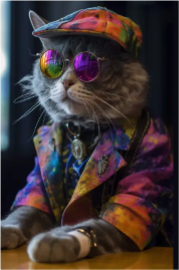
What is AI-generated art?
AI-generated art is imagery produced by a computer program from instructions given by a person. Usually the instruction is a written description, called a prompt, and the program generates a picture to match it.
How it works
The programs are built on machine learning. A neural network is trained on a vast number of existing images and their descriptions, and from them it learns the statistical patterns that link words to pictures. Given a new prompt, it produces a new image that fits those patterns.
The tools
There are many image generators, among them Midjourney, DALL-E and Stable Diffusion. Some can be tried free and others need a subscription, and the terms change often. Check what each tool's licence allows you to do with the images you make, especially if you want to sell them.
Advantages
New techniques
AI opens up new artistic possibilities. Artists can experiment quickly with patterns, textures and styles, and arrive at images that would have been very hard to make any other way.
Speed
AI saves time. It can produce complex designs, and many variations on an idea, far faster than anyone could draw them.
Open to everyone
People who have never learned to draw or paint can now make pictures. With less need for technical skill, the effort goes into the idea itself.
A help with restoration
Related technology is used to enhance scans of old photographs and artwork, which helps when making a copy of something too fragile to display.
Disadvantages
Emotion and authenticity
Many people feel that AI images lack the emotional connection and authenticity of work made by a person. A picture that does not come from lived experience, they argue, has no soul.
Reliance on the technology
If everyone uses the same tools, there is a danger that everything starts to look alike. Relying on a generator can discourage experiment beyond what the software does well.
Ethical and legal questions
These are the most serious concerns. The systems were trained on the work of human artists, often without their permission, and that is the subject of argument and of court cases. It is also unclear who, if anyone, owns the copyright in an image that a machine produced. The law is still catching up.
Framing your AI art
If you have spent hours refining a prompt to get the image you wanted, it deserves better than a phone screen. It can be shared online or shown on a digital frame, but a print on the wall gives it presence.
- Check the resolution. Many generators produce fairly small images. Use the tool's upscaling option before you print, and do not print larger than the file will bear.
- Mind the shape. AI images often come in proportions that do not match standard frames. A made-to-measure frame avoids having to crop.
- Think about the room. A calm landscape might suit a bedroom, and a fantasy portrait a home office or games room.
- Choose a frame that suits the picture. A frame and mount in harmony with the image pull it together and add to its impact.
Conclusion
Whatever you think of AI-generated art, it is here, and the tools are improving quickly. If you have made something you are pleased with, give it a proper frame and turn it into a statement piece.
Our picture frames are made to measure in a wide choice of designs, and we are glad to advise on the best frame for your artwork.
Call EasyFrame on 01234 856 501 or email sales@easyframe.co.uk. We are happy to talk it through even if you do not want to buy.