

Expert tips for safe packing
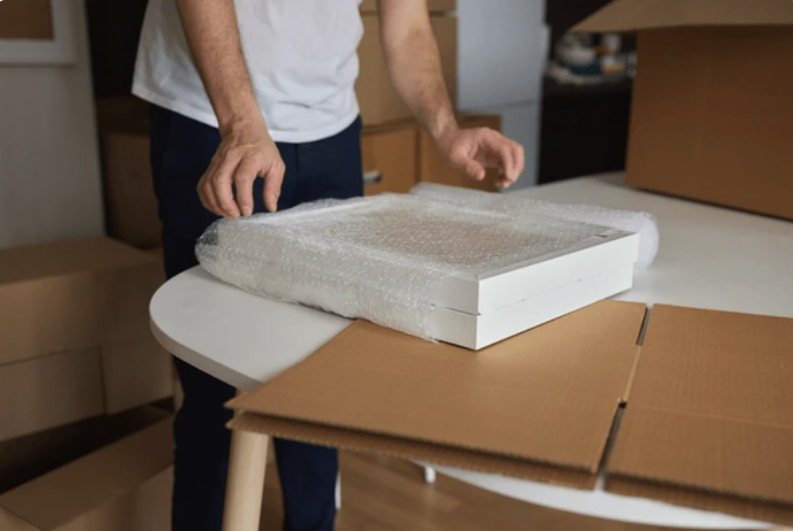
Moving house is stressful, and framed pictures are among the things most easily damaged. People often underestimate how much care they need. The key is to protect and cushion each frame well, and to stop it moving about.
You will need packing tape, bubble wrap, plain packing paper and strong boxes. Wrap every frame individually, pack the boxes so that nothing can shift, and label them clearly.
Preparing frames for packing
Materials
- Bubble wrap and packing paper, for cushioning. Use plain paper, because newspaper ink rubs off.
- Corner protectors, in card or foam, to guard the corners, which take most of the knocks.
- Glassine or acid-free tissue, to lay over unglazed artwork such as a canvas, so that nothing sticks to the surface.
- Picture or mirror boxes, flat cartons made for the purpose, and sheets of stout cardboard.
- Low-tack masking tape, for the glass.
Wrapping
- Lay the frame face up on a blanket or other soft surface.
- If it has glass, put a cross of masking tape over it. Should the glass break, the tape holds the pieces and helps protect the picture. Do not do this on acrylic glazing, or on an unglazed painting.
- Cover the front with a sheet of cardboard cut to size.
- Fit corner protectors.
- Wrap the whole frame in packing paper, then in bubble wrap, and tape the wrapping closed. Never put tape on the frame itself.
Packing the boxes
Use picture boxes
Picture and mirror boxes protect far better than ordinary cartons, because a frame fits them snugly. Many are telescopic and adjust to different sizes. Tape the bottom securely so that it cannot give way.
Stop frames moving
Stand frames on edge in the box, never flat, and pack them face to face and back to back so that hangers and fittings cannot scratch a front. Put cardboard between them. Fill every gap with crumpled paper, foam or a folded towel, so that nothing can shift when the box is tilted.
Label and list
Write 'Fragile' and 'This way up' on every side of the box with a marker pen. Number the boxes and keep a list of what is in each, so that nothing goes astray.
Loading and transport
In the van
Load pictures upright, on their edges, between soft, flat things such as mattresses or the backs of sofas. Do not lay them flat, and never stack anything on top of them. Large pictures travel best against the side of the van, tied or strapped so that they cannot slide or fall.
On the road
Tell the driver what is fragile. Drive steadily, and avoid sudden braking and sharp corners. On a long journey, check at a stop that nothing has worked loose.
Take anything especially valuable or sentimental in your own car, and check what your removal company's insurance covers before the day.
Unpacking and storage
Unpacking
Unpack on a clean, flat surface covered with a soft cloth. Cut the tape carefully, keeping the blade away from the frame. Check each picture for damage, such as cracked glass, loose corners or a slipped mount, and put any that need repair to one side.
Hang the pictures, or stand them somewhere safe, as soon as you can. A frame leaning against a wall in a busy house is likely to be knocked over. Use proper fixings when you hang them.
Longer-term storage
- Store pictures somewhere dry with a steady temperature. Lofts, cellars and garages swing between hot, cold and damp, which is bad for paper and wood.
- Wrap frames in acid-free paper or a clean cotton sheet. Bubble wrap is fine for a move, but it can trap moisture over months.
- Stand them upright, off the floor, with card between them. Do not put anything heavy on top.
If a frame does not survive the move, EasyFrame offers a wide range of made-to-measure frames and replacement glazing and mounts, and we can advise on the right choice. Call us on 01234 856 501 or email sales@easyframe.co.uk. We are always happy to talk, whether or not you want to buy.