

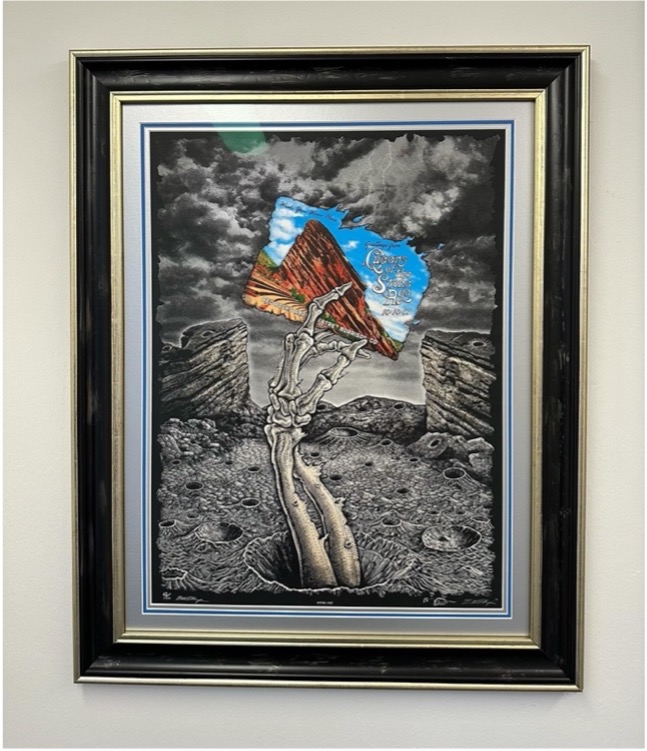
The right frame improves a picture and protects it, and getting the size right is the first step. A frame that fits holds the picture securely and leaves room for the glazing and, if you want one, a mount.
The short answer has two parts. Without a mount, the frame is made to the size of the picture. With a mount, the frame is bigger than the picture by the width of the mount border on each side. The rest of this guide explains the details.
Picture size, frame size and overall size
Three different measurements are involved, and they are easily confused.
| Measurement | What it means | Example |
|---|---|---|
| Picture size | The width and height of the artwork itself | 200 x 300mm |
| Frame size | The size of what fits inside the frame: the picture, or the picture and its mount | 200 x 300mm with no mount |
| Rebate | The lip at the front of the frame that overlaps the edges and holds everything in | About 5mm on each side |
| Overall size | The outside measurement of the finished frame, which depends on the width of the moulding | About 242 x 342mm in a 25mm moulding |
Frame size
When a frame is described as 200 x 300mm, that is the size of the picture it holds, not the outside of the frame. The framer cuts the frame a millimetre or two bigger than that, so that the glass, picture and backing drop in easily and have room to expand and contract with changes of temperature and humidity.
The rebate
The rebate is the lip that overlaps the edges of the picture, usually by about 5mm on each side. It stops everything falling out of the front. It also means that about 5mm of the picture is hidden along each edge, which matters if there is a signature or an important detail close to the edge.
Overall size
To work out how much wall the finished frame will cover, add the visible width of the moulding on each side.
- Picture: 200 x 300mm.
- Allowance for fitting: about 2mm in each direction.
- Moulding: 25mm wide, of which 5mm overlaps the picture, so 20mm extends beyond it on each side.
Overall size: (200 + 2 + 40) x (300 + 2 + 40) = 242 x 342mm.
Adding a mount
What a mount does
A mount protects the picture by keeping it away from the glass, which matters for photographs and delicate work that could stick to it or be marked by condensation. It also separates the picture from the frame, draws the eye in and sets off the colours.
How a mount changes the frame size
With a mount, the frame is made to the outside size of the mount, not the picture. The border is commonly 1 to 3 inches (2.5 to 8cm) on each side.
The window in the mount is cut slightly smaller than the picture, so that the mount overlaps its edges and holds it in place. For a 10 x 8 inch photo the window is typically about 9.75 x 7.75 inches, which hides an eighth of an inch (3mm) along each edge.
For example, a 10 x 8 inch photo with a 2 inch border needs a frame of about 14 x 12 inches.
How wide should the border be?
It depends on the size and style of the picture. A wider border makes a picture look more important and more refined. A border that is too narrow looks cramped, and the picture can be overshadowed by the frame. If you can, try several widths before you decide.
Choosing the frame
Sizes and styles
Ready-made frames follow the standard photo sizes, such as 6 x 4, 7 x 5 and 10 x 8 inches (15 x 10, 18 x 13 and 25 x 20cm). For anything else, a made-to-measure frame will fit exactly.
Style matters as much as size. Consider the subject, colours and mood of the picture, and the room where it will hang.
Making it your own
You can choose the colour, material and finish of the frame to match the artwork and the room, and add a mount in a colour that works with both.
Trends
Many people now prefer plain, minimalist frames that let the artwork take centre stage. Mixing frame materials and colours on one wall is popular too. So are float frames for canvases, in which the picture seems to float inside the frame with a narrow gap all round.
Other things to consider
Glazing
Glazing shields the picture from dust, moisture and UV light. Glass is clear and resists scratches, but it is heavy and can shatter. Acrylic is light and shatter-resistant, which makes it the safer choice for large frames, but it scratches more easily.
A checklist
- Measure carefully. Measure the width and height of the artwork in millimetres, in more than one place, as paper is not always perfectly square.
- Match the moulding to the size. A large picture needs a wider, stronger moulding to carry the weight of the glazing. A very thin frame is only suitable for small pictures.
- Decide on a mount. If you want one, choose the border width, and remember that the frame size grows with it.
- Treat canvas differently. A stretched canvas is usually framed without glazing, in a deeper moulding or a float frame.
- Check the resolution. A photo must have enough resolution for the size at which it is printed, or it will look soft or blocky.
EasyFrame offers a wide range of made-to-measure frames. You enter the size of your picture, and the frame and mount are made to fit. With long experience we can advise on the right choice for your artwork. Call us on 01234 856 501 or email sales@easyframe.co.uk. We are always happy to talk, whether or not you want to buy.