

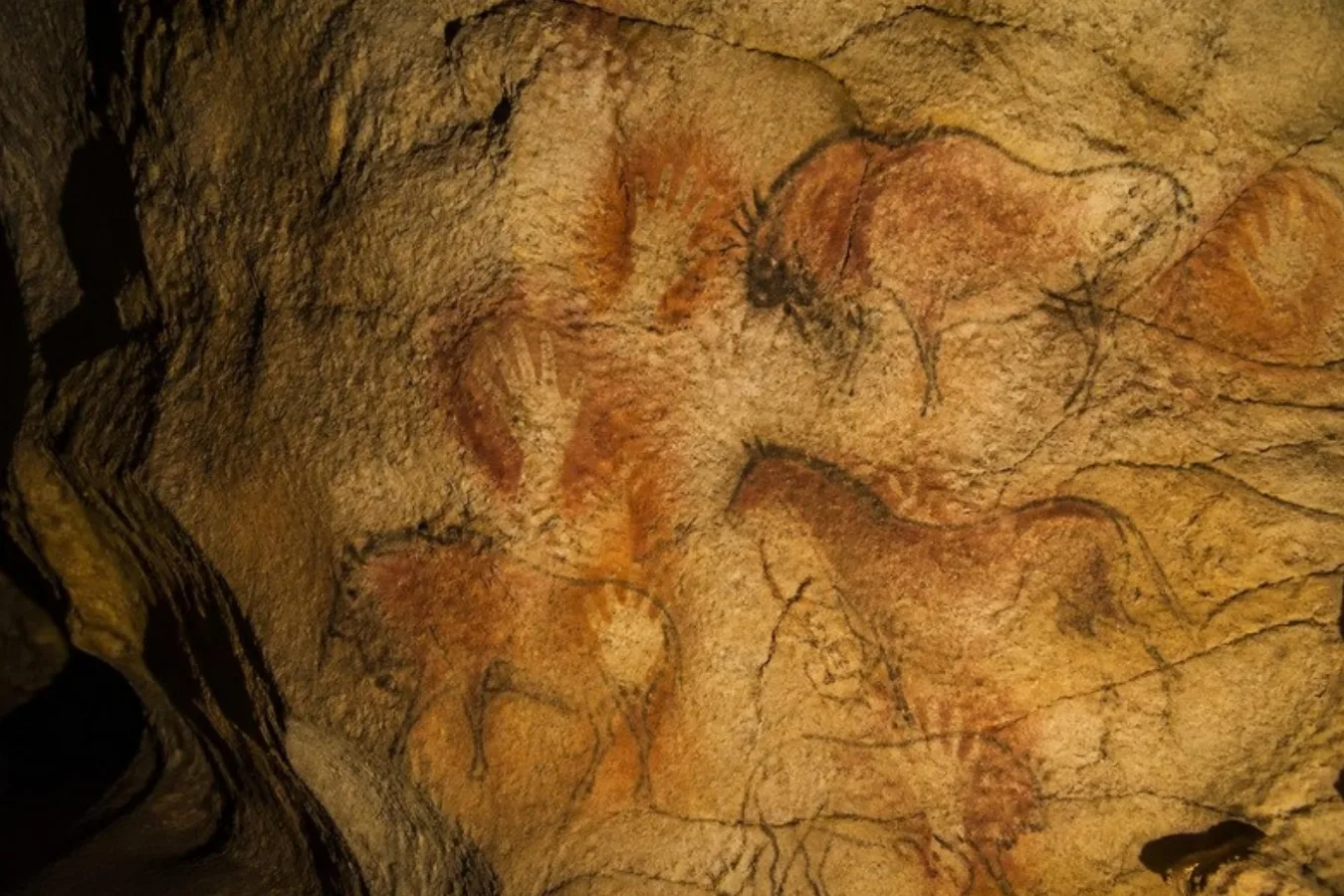
At EasyFrame we are dedicated to picture frames and mounts, but we also love the art that will not fit in a frame. So it will not surprise you that we are fascinated by ancient cave art. We decided to look at the facts and see how much we really knew.
The earliest art
Cave paintings, also called parietal art, are prehistoric images painted on the walls and ceilings of caves. They are found in many parts of the world, and the oldest known are at least 40,000 years old.
Until recently the oldest were thought to be in Europe. That changed in 2014, when researchers took a fresh look at cave art on the Indonesian island of Sulawesi and found that earlier estimates of about 10,000 years were far too low.
The hand stencils in the Sulawesi caves are now counted among the oldest cave paintings known, along with the red discs in the cave of El Castillo in Spain. It suggests that cave art did not begin in Europe and spread from there. It appeared across the inhabited world.
These early works were made by blowing pigment at the wall, often around a hand held against the rock. Minerals such as red and yellow ochre, and charcoal, are thought to have been mixed with animal fat or saliva, which helped the colour stick to the stone. That is why we can still see it tens of thousands of years later.
Some of this art is so old that scientists have suggested part of it may be the work of Neanderthals.
Figurative art
Hand stencils are among the earliest art yet discovered. Figurative art, which shows a recognisable animal, person or object, is known from at least 30,000 to 35,000 years ago. Among the best evidence is the Chauvet Cave in France, with its superb paintings of animals. Scientists have argued over their exact age, but they are generally thought to be more than 30,000 years old.
Animals and humans
Certain animals appear again and again in cave paintings: bison, horses and deer, and the extinct aurochs, a large horned wild ox. Chauvet also has lions, bears, hyenas and rhinoceroses.
What the painters felt about these animals is far from clear. There are several theories:
- Hunting magic. Many have thought the paintings were a way to capture an animal's spirit and so hunt it more easily. But at Lascaux in France, horses dominate the walls, while the bones found in the cave show that reindeer were the main prey, and reindeer hardly appear in the paintings.
- Homage to nature. That has led some to suggest the paintings honour the power of the natural world.
- Visions. Others propose that shamans withdrew into the caves to experience visions, and recorded them on the rock.
- Art for its own sake. And some believe the paintings are simply evidence of the human need to make art.
Images of people are much rarer, and when they do appear they are cruder and simpler. Nobody knows why. One theory is that people were wary of showing themselves too clearly, perhaps because of a religious taboo.
Other prehistoric art
Cave paintings are the best-known prehistoric art, but there are other kinds that are just as fascinating. Some scientists believe the artistic impulse goes back as far as 500,000 years, to the time of Homo erectus. The evidence is a shell found in Java, engraved with a zigzag pattern.
While bison and hand prints were appearing on cave walls, people were also making sculpture. Some 'Venus figurines', small carvings of a simplified female form, are at least 35,000 years old. Other ancient carvings include animals such as the Swimming Reindeer in the British Museum, and petroglyphs, which are images cut into rock.
Make your home a treasure trove of art
We do not spend much time in caves now, but we can still take inspiration from our artistic ancestors. If you feel adventurous, try a mural. Even the least artistic of us can manage a hand stencil.
Otherwise, invest in some prints, photographs or illustrations and visit EasyFrame. We offer affordable made-to-measure picture frames and mounts, and multi-aperture frames, in a wide choice of colours and finishes.