

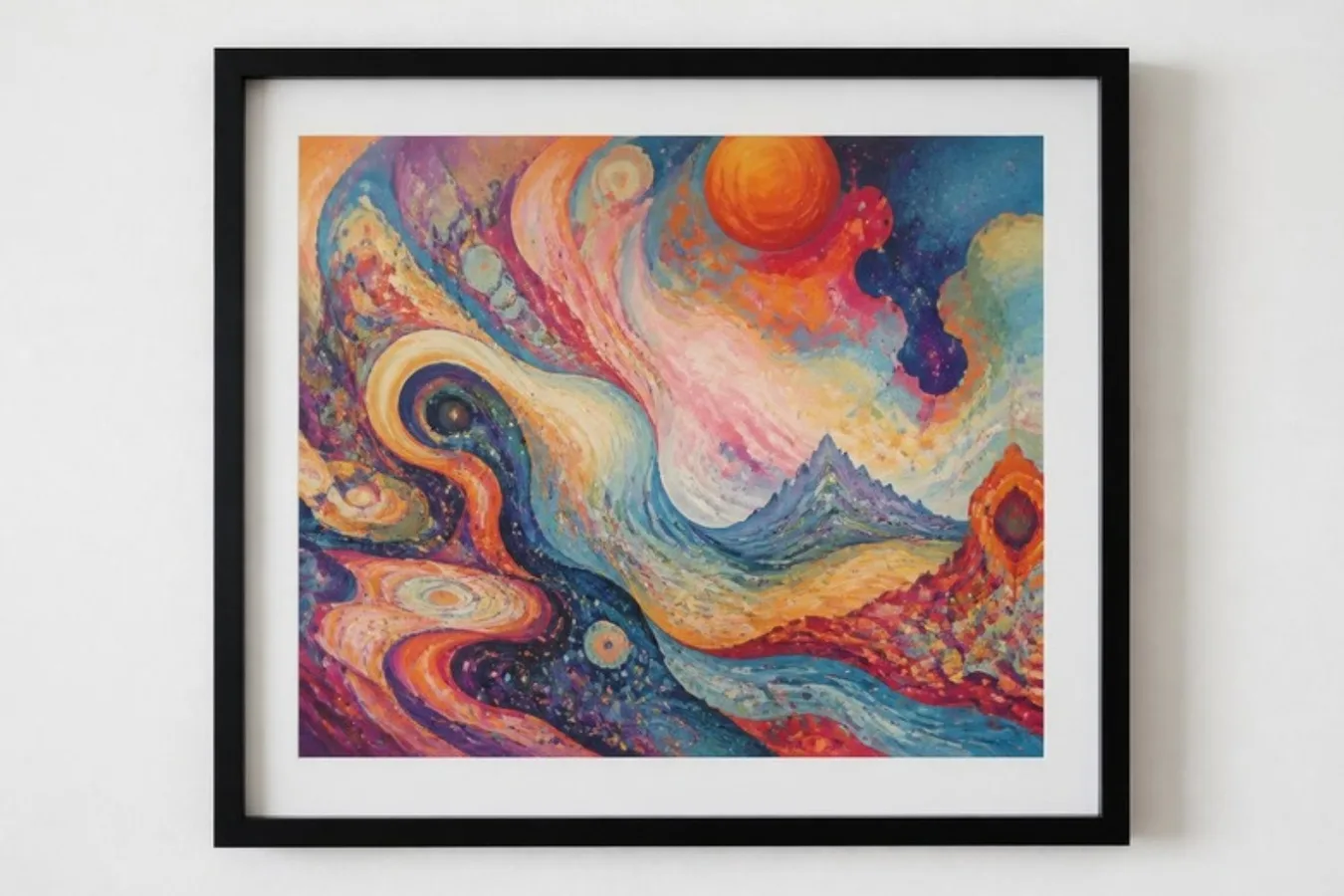
Even if you haven't heard of Google's DeepDream software, you have almost certainly seen its images around the web. Somewhere between a magic eye picture and a hallucination, they are memorable for their vivid swirling colours and intricate repeating patterns.
DeepDream began as software designed to detect faces and other patterns in pictures, much like the technology in your phone camera that recognises who's who among your friends. It compares patterns in an image against a huge bank of stock photos to identify faces and objects. DeepDream then teases those patterns out, pushing them to look more and more like objects, faces or animals. Often it draws them from the tiniest random patterns, filling a picture with faces, buildings and cars that seem to come from thin air.
Is this the future of art?
Most DeepDream images are not especially interesting, but there are a few you could imagine framing and hanging on your wall. The best have art experts wondering whether this could be the future of art.
Two hundred years ago an artist was a well-educated person who learnt the trade over many years, studying with established artists and learning to draw, paint and sculpt. Today "artist" is a far broader term. It covers many skills and overlaps with architecture, film, dance, music and poetry. Walk into any modern gallery and you may meet conceptual art, which puts the idea ahead of traditional skill.
If conceptual art has opened the art world to wider interpretations, should DeepDream images hang in galleries too? That depends on whether you think art can be generated by a machine, or whether it needs the direct involvement of a human.
For the experts the answer is simple. The images are art, not because of how they look, but because they do what great art should: raise questions about humanity and the modern world. The writer and curator Dylan Kerr was quoted in The Guardian arguing for the value of AI-generated images: "What really distinguishes DeepDream is the machine learning techniques used to generate the images, rather than the images themselves".
Kerr's point is that DeepDream is another major step towards artificial intelligence that can rival, and in some areas outstrip, the human brain. Whether or not you enjoy looking at an AI-generated image, that is an idea worth discussing.